




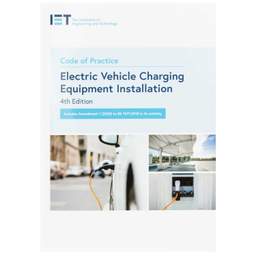
The IET Code of Practice 4th Edition provides an overview of EV charging equipment and has been updated in line with recent changes to BS 7671 [IET Wiring Regulations]. It reflects some major developments in this area including vehicle to grid, smart integration and inductive charging. Therefore, before any installation, make sure you’re up to speed with the new requirements.
Essential reading for those procuring, installing, managing or otherwise working on EV charging stations, the IET Code of Practice considers pre-installation and the physical and electrical requirements in accordance.
 Incorrect charging could overload a plug and cable
Wrongly installed EV charging equipment could cause electrical fires
A fault in the electrical supply could make a car live while on charge
Death or injury could be caused by misuse of adapters and extension leads
Incorrect charging could overload a plug and cable
Wrongly installed EV charging equipment could cause electrical fires
A fault in the electrical supply could make a car live while on charge
Death or injury could be caused by misuse of adapters and extension leads
The Code of Practice is aimed at installers, competent electricians, procurers who specify EV installation work, design engineers [those who manufacture EV charging equipment and vehicles], and the electricity supply companies. It is also used to communicate EV electrical safety to the public. Therefore, it is vital that you are aware of the detail within the latest regulations.
With these in mind, the Code of Practice has been fully updated to reflect the 18th Edition of the IET Wiring Regulations, including the new requirements around the use of PME [Protective Multiple Earthing]. It also references all relevant European and international standards.
